Mathematical Introduction: Using the Bloch sphere to represent a qubit

Overview
Overview
Keywords: qubit, Bloch sphere
Age group: 16-18 years
Required knowledge/skills: trigonometry, complex numbers (see below for details)
Time frame: 30 minutes
This section is part of Basic Concepts of Quantum Computing – Mathematical Basics written by Natalija Budinski (RS).

The students should know:
- what a complex number is and that it can be represented by with
- that a complex number can also be written in a trigonometric or in an exponential form:
- that the state of a qubit can be represented by: with
See lessons “Matrices and how they can be used in quantum computing” [link], “Introduction to complex numbers” [link], and “What is a qubit?” [link to 5.1/5.4 Qubits].
Required materials
- paper and pencil
Key idea
Let us consider a qubit represented by , where, in the most general case, and are complex numbers. At first sight, four parameters – the real and imaginary parts of , and the real and imaginary parts of – are needed to determine the state of the qubit.
The state of the qubit can also be written in an exponential form:
In this equation, two real numbers ( and ) and two angles ( and ) are needed to describe the state of the qubit – so, still four parameters.
The connection between the two representations is as follows:
, where and are the real and imaginary parts of ; and are two real numbers.
In general, one can write a complex number as:
By comparing these two equations for , one gets:
and
Likewise for .
Eliminating two parameters
One can now factorise out :
or after omitting the so-called global phase :
with
Hence, measurable properties of the qubit state depend only on , and the relative phase . The global phase does not affect the outcome of a measurement. This leaves us with three parameters needed to describe the qubit state.
→ We are left with three parameters due to the elimination of a global phase.
To understand the meaning of a global phase, think of it as follows: when you want to determine the amplitude and frequency of a wave, it doesn’t matter when you start to measure (when the amplitude is at its maximum, or when it is zero, or when it is at its minimum), so time is like a global phase, it does not affect the measurement of the amplitude or frequency.
If one performs a measurement on a qubit described by the state , the probability of finding it in state is , and the probability of finding it in state is (see “Basics of Quantum Physics” [link]). These two probabilities sum up to 1:
Let us now jump to a very similar equation we know from trigonometry. The equation is valid for any angle, but for reasons that will become clear later, we choose the angle .
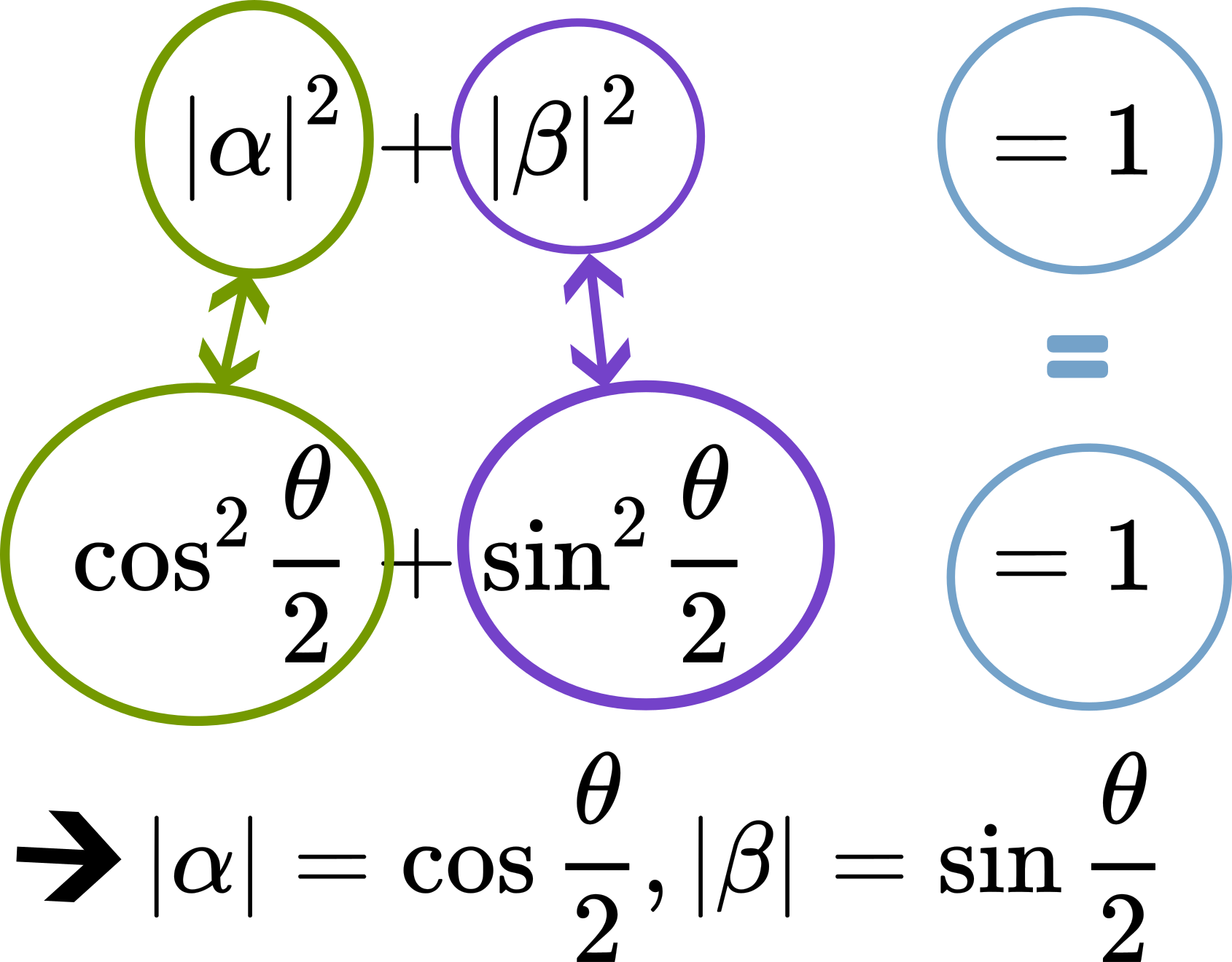
By comparing the two equations, one can write and as a function of the angle :
and
with
Or, if we go back to the general description of a qubit state:
The interval reflects the fact that because of the normalisation relation , and are real numbers between 0 and 1: . and can be visualised as coordinates on a quarter circle in the first quadrant of the sphere (both numbers are nonnegative).
→ We are left with merely two parameters due to the normalisation relation .
Conclusion
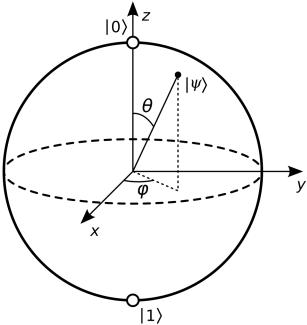
Combining these ideas and writing and as functions of and leads to the Bloch sphere description of a qubit state:
with and .
On the Bloch sphere:
- (polar angle) spans from 0 to π;
- (azimuthal angle) spans from 0 to 2π.
→ Hence, a qubit state can be described by only two parameters: two angles.
Any pair of angles corresponds to exactly one point on the surface of the unit sphere, and therefore to one unique qubit state (up to a global phase).
Special cases
- If : the qubit state is represented by the “North pole” of the Bloch sphere.
- If : the qubit state is represented by the “South pole” of the Bloch sphere.
- If , the states are on the equator, the probabilities of measuring and are the same. However, there are many different states fulfilling this condition, not just one.
The Bloch sphere provides an elegant way to picture any single-qubit state with just two real parameters, and .
Teacher tip
Find interactive representation of the Bloch sphere representation of quantum gates acting on single qubits at Wolfram Demonstrations Project.
(last accessed 27.02.2026)
- A
- A
- B
- B
- A
Share this page