Quantum Computing in STEM Education
One of our member countries, Science on Stage Germany, works with secondary school teachers from all over Europe in an international project to develop teaching materials on "Quantum Computing in STEM Education".
Aims of the project
Development and testing of teaching materials on the subject of quantum computing in STEM education with the following goals:
- Usable directly in physics, mathematics and/or computer science classes by teachers with little previous experience;
- Get students excited about the topic of quantum computing and show career opportunities in this area;
- Students get to know the underlying, fundamental quantum mechanical concepts;
- Promote analytical and critical thinking, teamwork and problem-solving skills;
- Clarify the relevance of this technology for the future.
Outcome
Free digital teaching resources for computer science, physics and mathematics lessons have been published in June 2026. They include hands-on experiments and interactive worksheets for students aged 16–18.
What makes quantum computing so relevant?
Quantum computers have the potential to fundamentally change our lives in many areas. Dealing with this topic at school prepares students to later actively participate in the design of this future technology. But how can we implement this very relevant topic into the classroom and bring it closer to students?
We asked participants, experts and coordinators of the project what makes the topic of quantum computing so exciting.
Outlook
To support the dissemination in the countries, international webinars in English and German are planned for the school year 2026/27 as well as workshop by the authors of the teaching materials in various countries.
Stay informed
Subscribe if you want to receive news about the projects and other activities connected to quantum computing (teacher training, webinars, opportunities to participate, etc.). We send around 2-3 emails per year. You can unsubscribe at any time here.
Timeline
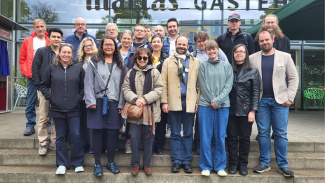
In February 2024, 20 teachers from 15 countries came together in Berlin for the start of the two year cooperation. Supported by the project coordinators and experts, they spent a whole weekend discussing how this topic can be implemented in classrooms all over Europe and brainstormed concrete teaching ideas. Over the upcoming months, the teachers will work in teams to develop tried-and-tested teaching materials on quantum computing which can be directly used by teachers in different subjects as well as used interdisciplinary.
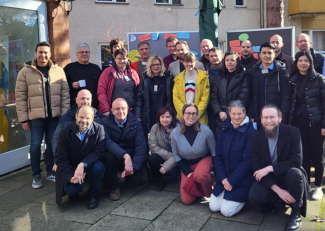
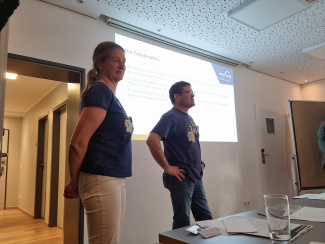
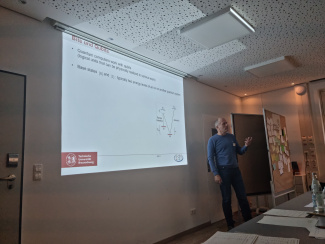
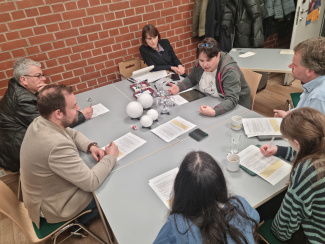
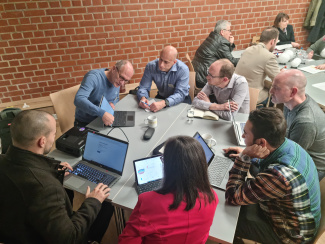

Teachers discussed how quantum computing can be introduced in the classroom, focusing on implementation challenges and the need for accessible materials that support educators and engage students across subjects and levels.
Project groups shared the current state of their teaching materials and identified overlaps and connections. The meeting highlighted the goal of developing coherent, classroom‑tested materials that offer low‑threshold access to quantum computing and motivate both teachers and students.
Throughout 2024, all project groups continuously developed their teaching materials independently, sharing progress and coordinating to ensure coherence and avoid overlap.
Throughout 2025, the project’s working groups met regularly in person and online to further develop and refine their teaching materials. These meetings supported content alignment, testing of experiments, and the development of interactive elements, with ongoing coordination and feedback from the project coordinators.
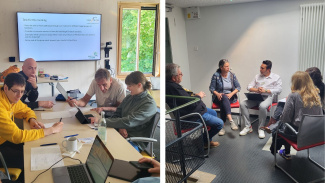
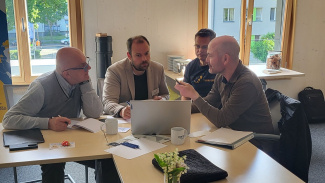
The second in‑person project meeting in Berlin focused on finalising the teaching units developed by the four working groups and planning the remaining steps towards publication in April 2026. Participants worked intensively in their groups, received feedback from coordinators and external experts, and agreed on a shared timeline for the final project phase.
Key topics included didactic alignment across subjects and grade levels, the development of interdisciplinary learning pathways for physics, mathematics and computer science, and the definition of common quality criteria. By clearly coordinating and delimiting the content of the working groups, the project moved closer to a coherent, accessible set of teaching materials that combines real‑world applications with low‑threshold entry points for classroom practice.
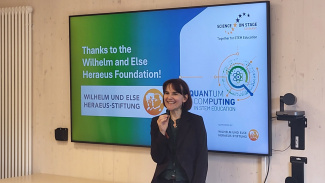
In the context of the International Year of Quantum Science and Technology 2025, the project was presented at a wide range of national and international events. Through workshops, conference contributions and panel discussions, teachers were introduced to quantum computing and gained early insights into the developing teaching materials.
Activities took place across Europe and online, including teacher training courses, Science on Stage festivals, professional conferences and networking events. A strong focus was placed on exchange with the teaching community and on preparing educators for the future use of the materials in the classroom. Key partnerships included close collaboration with the German Physical Society (DPG), as well as contributions to initiatives such as the Stifterverband’s Quantum Skills programme.
During the final project phase, the teaching materials are reviewed, refined and prepared for publication. The working groups incorporate feedback from previous meetings and pilot use, ensure didactic consistency across subjects and levels, and align content, terminology and structure. This phase also includes final quality checks and the preparation of the materials for publication on the project website in English and German.
Coordination and expertise
Coordinators
Dr Jörg Gutschank, Leibniz Gymnasium I Dortmund International School, Chair Science on Stage Germany
Dr Zdeňka Koupilová, Department of Physics Education, Faculty of Mathematics and Physics, Charles University, Prague, Czech Republic
Dr Jenny Schlüpmann, Physics Department, Freie Universität Berlin, Executive Board Science on Stage Germany
Experts
Prof Dr Stefan Heusler, Institute of Physics Didactics, University of Münster
Prof Dr Rainer Müller, Institute for Didactics of Natural Sciences, Dept. of Physics and Physics Didactics, Technische Universität Braunschweig
Nils Haverkamp, Institute of Physics Didactics, University of Münster
Dr. Andreas Fuchs, Institute of Physics Didactics, University of Freiburg
Dr Stefan Seegerer, IQM Quantum Computers
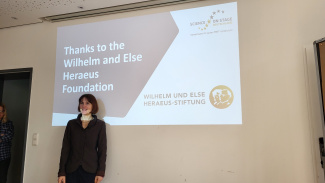
Supported by the

Contact us
contact person
Daniela Neumann
Share this page