Think. Design. Build: Engineering Training for Teachers in Romania
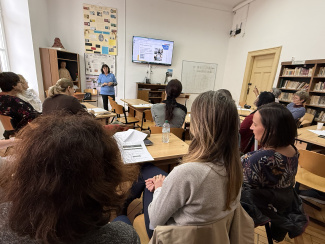
On 16 October 2026, 20 secondary school teachers took part in the three-hour hands-on engineering workshop “Think. Design. Build – Engineering in School” at Colegiul National Gheorghe Lazar in Sibiu, Romania. The training brought together 14 STEM teachers – covering Mathematics, Physics, Chemistry, Biology and Computer Science – and six language teachers of English and German. The activity was supported by the Science on Stage Engineering Grant.
The workshop was held in the audio-visual room in the school library and was organised to support the implementation of Romania’s revised Grade 9 curriculum from September 2026, particularly in bilingual classes where non-language and CLIL subjects must be taught in English or German.
During the “Experiencing an engineering challenge” activity, participants worked in small mixed teams (teachers of various subjects) to design, build, test, and improve a working catapult using wooden craft sticks and a limited range of simple materials, including rubber bands, a plastic spoon and ice cream sticks. Their goal was to launch a lightweight paper ball as far as possible, with the final designs tested in a friendly competition.
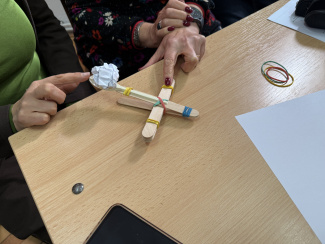
The activity followed the Engineering Design Process: participants identified the goal and constraints, brainstormed and sketched possible solutions, built a prototype, measured its performance, evaluated the results and refined the design through repeated testing. The main engineering aspects explored included force and motion, potential and kinetic energy, lever action, structural stability, material choice, measurement, and optimisation.
Particular emphasis was placed on iterative problem-solving: participants analysed why one design performed better than another and explained how specific modifications improved the catapult’s range, stability or efficiency. Knowledge of iterative problem-solving is valuable for language teachers because it closely mirrors the process of language learning itself. Learners rarely produce a perfect answer, text, or presentation on their first attempt: they try, receive feedback, identify what is not working, revise their approach, and try again.
By understanding the engineering cycle of designing, testing, evaluating, and improving, language teachers could help students see mistakes not as failures but as useful evidence for the next step. In CLIL-based lessons, this also enables teachers to support students in explaining decisions, comparing results, justifying modifications, negotiating ideas, and reflecting on progress. Iteration therefore develops both problem-solving skills and meaningful language use, especially the language of cause and effect, hypotheses, comparison, evaluation and improvement.
Participants teach students aged 13–17. Bringing subject and language teachers together encouraged interdisciplinary planning; in the long run, it can help ensure that engineering concepts are taught in ways that are both scientifically rigorous and linguistically accessible.
Participants left with a classroom-ready engineering activity, practical CLIL strategies and a shared basis for future collaboration between STEM and language teachers.
Report: Daniela Bunea
Supported by

Share this page