Teachers’ Perspectives on the Future of STEM Education: Survey Results & Position Paper
Europe's ambition to become a global leader in innovation depends on one group of professionals more than any other: STEM teachers. Every European STEM strategy could ultimately succeed – or fail – from the actions in classrooms.
STEM education plays a crucial role in preparing young people for a rapidly changing world. Teachers are at the heart of this transformation: they implement new curricula, introduce emerging topics such as artificial intelligence and sustainability, and help students develop the competences and skills needed for the future.
As Europe's largest network of STEM teachers, the grassroot initiative, Science on Stage Europe reaches more than 100,000 teachers in more than 30 countries. To better understand the realities and needs of classroom practice, Science on Stage conducted an anonymous online survey among its network of teachers.
The survey was very focused with its questioning and asked: What are the current priorities, challenges and support needs of STEM teachers, and how can STEM education be better supported for the future?
Based on the survey results, Science on Stage Europe developed recommendations for policymakers in form of a position paper with the aim to bring the voices and perspectives of STEM teachers into the European policy debate.
With our position paper, we aim to bring teachers’ voices into the current discussion. When it comes to the development of the European STEM Competence Framework or the Teachers Agenda, which is currently being worked on by the European Commission, it is important to listen to those who are in the classrooms.
The anonymous online survey was conducted over a two-month period, from mid-May to mid-July 2026. It combined multiple-choice questions with open-ended questions to capture both quantitative data and teachers' personal perspectives.
The survey was disseminated through the Science on Stage network, including the International Science on Stage Festival 2026, Science on Stage newsletters, and the National Steering Committees of each member country.
In total:
- 165 completed responses
- 33 countries represented
- Teachers from early childhood to higher education
- STEM subjects represented, particularly physics, mathematics, biology, general sciences and chemistry, alongside interdisciplinary STEM, engineering, robotics, computer science and teacher education.
The broad participation provides a diverse snapshot of teachers' experiences across different educational systems and STEM disciplines.
Survey results
Needs & Challenges: More time and collaboration
Across several survey questions, one message emerged consistently: Time is the teachers' most limited resource. When asked what supports they needed respondents most frequently selected:
- Time for collaboration with colleagues (56%)
- More time for planning, teaching and professional development (51%)
- Access to inspirational and innovative ideas (48%)
The same pattern appeared when teachers described their daily challenges.
Teaching Resources: More hands-on and interdisciplinary
Respondents expressed a strong demand for practical classroom resources. The most frequently requested topics for future teaching materials were:
- Hands-on experiments (49%)
- Interdisciplinary STEM (45%)
- Innovative teaching methods (42%)
- AI in education (37%)
Teachers emphasised that they wanted materials that can be directly implemented and adapted to their own classrooms.
*Up to three options could be selected here
System change: Interdisciplinary teaching and more time
Teachers also identified several systemic changes that would strengthen STEM education. The strongest demand was for more interdisciplinary teaching opportunities and additional time for integrated projects, selected by 63% of respondents. This was followed by a call for greater funding and resources (53%), while one third of teachers (34%) identified more teacher training opportunities as a key priority.
*Up to three options could be selected here
Change in STEM education: More hands-on, more connected to real life
The open-ended responses reveal a consistent vision for the future of STEM education. Teachers repeatedly called for:
- more inquiry-based, hands-on and project-based learning;
- stronger connections to real-world challenges and future careers;
- greater collaboration between teachers, schools and external partners;
- more curriculum flexibility;
- increased emphasis on creativity, critical thinking, and innovation.
As one respondent stated:
"The most important change needed in STEM education is shifting from memorization of facts to inquiry-based, hands-on learning that develops critical thinking, creativity, problem-solving, and real-world skills."
Another teacher highlighted the importance of collaboration:
"Teachers need time and opportunities to collaborate, supported by clear leadership and a stable education system that provides schools with the consistency and peace needed to focus on teaching and learning."
Future Skills
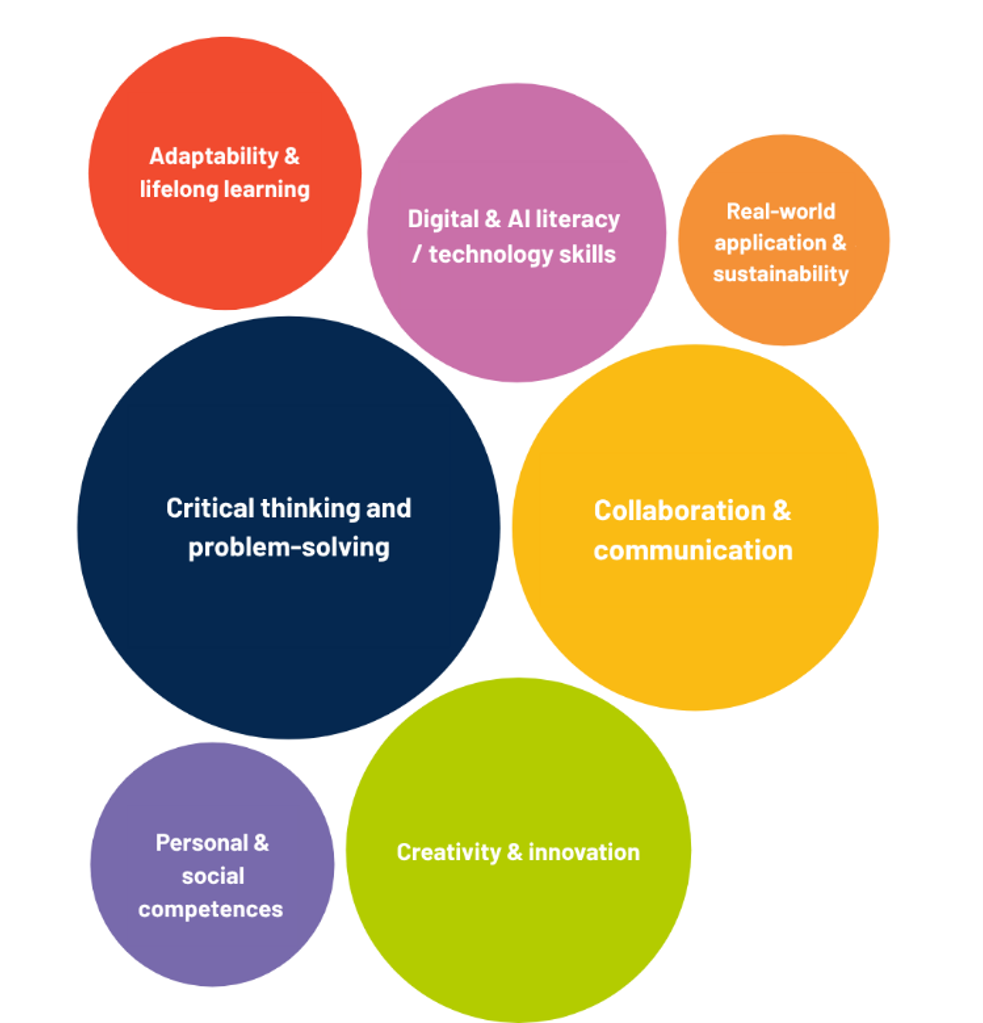
When asked about the competences or skills students will need in the future, teachers overwhelmingly highlighted transversal skills.
"Students should solve real-world problems, collaborate in teams, and connect science, technology, engineering, arts, and mathematics."
Science on Stage Position Paper
Based on the survey results, Science on Stage Europe developed recommendations for policymakers to bring the voices and perspectives of STEM teachers into the European policy debate.
Read it here!
Share this page