Virtual Reality in Education: Transforming the Learning Experience
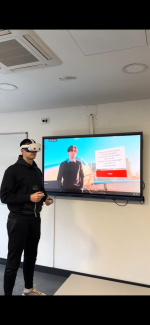
School students today follow modern technological trends and are surrounded by digital content on a daily basis, which is why traditional teaching methods are often not sufficient to fully maintain their attention and motivation. For this reason, the use of VR headsets in teaching represents one of the most innovative approaches in education.
Learning through virtual reality allows students to experience educational content in a completely new and interactive way. Instead of only reading or looking at pictures in textbooks, they can “enter” specific situations and environments and gain a more realistic understanding of what they are learning. This approach significantly increases student engagement and encourages active learning.
VR technology enables simulations that would be difficult or impossible to carry out in real life. For example, students can “visit” historical events, explore the human body from the inside, or observe chemical reactions in a controlled virtual environment. In this way, abstract concepts become much clearer and easier to understand.
The special value of VR learning lies in its ability to promote experiential learning. Students do not acquire knowledge only theoretically, but through experience and interaction, which contributes to better memory retention and a longer-lasting understanding of the material. It also fosters their curiosity, creativity, and problem-solving skills.
Most school subjects can be adapted to this form of teaching. In natural sciences, students can explore natural phenomena, in geography, they can “travel” through different countries and continents, while in art, they can virtually visit museums and galleries around the world. Even vocational subjects gain a new dimension through practical simulations.
The application of VR technology in teaching also contributes to more inclusive education, as it allows students with different learning styles to more easily master the material. Visual, auditory, and kinesthetic learners all benefit from this approach.
In conclusion, it can be said that VR headsets in education are not only a technological innovation but also an important step towards the modernisation of education. They make learning more interesting, accessible, and effective, preparing students for a future world in which digital skills and innovative thinking are of key importance.
Report: Andrijana Vasić
Share this page