Exploring Machine Learning in Practice: A Teacher Training Workshop in Toulouse
On May 13th, a group of science and technology teachers from various secondary schools in Toulouse and the surrounding area gathered at Fablab Toulouse Nord for a workshop focused on machine learning and artificial intelligence. Supported by Science on Stage Germany through an AI Literacy Grant, the workshop aimed to equip teachers with practical ideas and activities they could bring into their own classrooms to introduce these topics to their students in an engaging way.
The event brought together 21 lower secondary teachers from the fields of mathematics, science, and technology. The session was led by Simone Ferrecchia, a science and technology teacher at Collège Henri de Toulouse Lautrec in Toulouse, alongside Julia Houdin, a graduate student in electronic engineering at INSA University of Rennes, who contributed significantly to the workshop by delivering key presentations.
The workshop began with an introductory session in which participants had the opportunity to get to know each other and share their current practices related to teaching AI and machine learning. This exchange allowed teachers to reflect on their own experiences and learn from one another. During this part, the participants were also introduced to the European network for STEM teachers, Science on Stage.
Following this introduction, the focus shifted to building foundational knowledge. Julia Houdin delivered a presentation introducing key concepts in artificial intelligence and machine learning. Participants were then guided through a practical exploration of the “Machine Learning for Kids” web application. This tool, which is based on the Scratch visual programming environment, allowed teachers to create simple machine learning models themselves. Thanks to their familiarity with Scratch, participants were quickly able to experiment with building models capable of recognizing text, numbers, or drawings. This hands-on experience helped make abstract concepts more tangible and demonstrated how such activities could be adapted for classroom use.
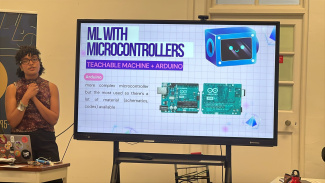
In the final part of the workshop, the emphasis moved toward connecting machine learning with physical computing. Julia Houdin introduced the concept of interfacing machine learning models with microcontrollers, enabling the creation of interactive devices. Participants were presented with the “Tiny Sorter” experiment developed by Google, which demonstrates how machine learning can be used to sort objects based on characteristics such as color, shape, or type. Although there was not enough time to carry out practical experiments with the Tiny Sorter during the session, teachers were able to explore the “Teachable Machine” online. This tool allows users to create custom machine learning models and upload the corresponding code to an Arduino board, which can then control sensors and actuators.
Overall, the workshop provided participants with both conceptual understanding and practical tools to integrate machine learning and artificial intelligence into their teaching. By combining accessible digital tools with hands-on experimentation, the session highlighted how these emerging topics can be taught in a way that is both engaging and aligned with existing science and technology curricula.
Report by: Simone Ferrecchia, science and technology teacher at Collège Henri de Toulouse Lautrec in Toulouse
Supported by

Share this page