Quantum Computing Teaching Material Glossary

Overview
Algorithm
A quantum algorithm is a set of instructions for solving a problem, each instruction being carried out by a quantum computer – similarly to what a classical algorithm is for a conventional computer. The term algorithm is named after the Persian polymath Muhammad ibn Musa al-Khwarizmi.
Big O notation
Describes how fast one function grows compared to another if its argument tends to infinity. In computer science, the Big O notation helps to classify algorithms according to the increase in runtime relative to the increase of the input.
Bloch sphere
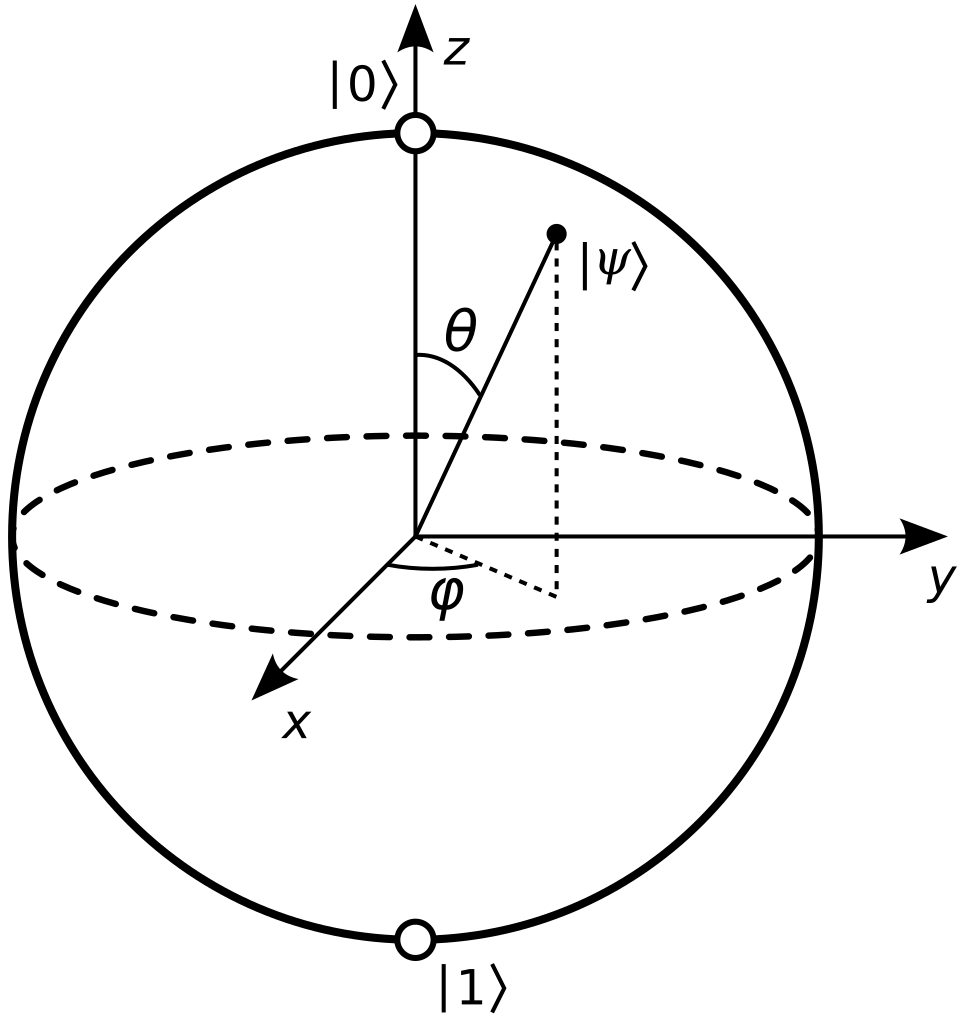
The Bloch sphere is a graphical representation that helps to visualise states of a qubit as points on the surface of a unit sphere. The North pole of the Bloch sphere corresponds to the state , while the South pole corresponds to the state . The term is named after the Swiss-American physicist Felix Bloch.
Collapse (reduction) of the state
When measuring a physical quantity with a suitable measuring device, the state of the studied quantum system changes. This is referred to as the collapse (or reduction) of the state, as the measurement yields one specific result out of a set of possible outcomes.
Entanglement
In quantum mechanics, it is possible to create a system of two (or more) particles in which the state of one particle inherently depends on the state of the other particle(s). In other words, if we perform a measurement on one particle, this automatically determines the outcome of a measurement (whether actually performed or not) on the other particle(s), including the case when the particles are separated by a large distance. Entanglement does not have a counterpart in classical physics.
Measurement
To perform a measurement means to determine a physical quantity (e.g. position, energy, momentum, polarisation etc.) by using a suitable apparatus or device.
In classical physics, measurement is deterministic: It is possible to prepare a system in such a way that the value of the physical entity one wants to measure is always the same when repeating the measurement of the same object in the same state.
In quantum physics, on the other hand, the outcome of a measurement of a quantum object can only be predicted with a certain probability, and it only becomes certain when actually performing the measurement. Performing a measurement may change the state of the quantum object: a measurement leads to the collapse of the state.
No-cloning theorem
The no-cloning theorem states that it is not possible to copy an unknown quantum state. When attempting to copy it – which is equivalent to performing a measurement on that state –, the quantum state changes (see measurement and collapse of the state). This has a direct consequence for quantum cryptography: If somebody tries to eavesdrop on a communication encoded by a key, he/she will change the key and, hence, the eavesdropping attempt will be revealed to the rightful owners of the quantum key.
Probability
The probability describes how likely a certain event will occur or how likely it is to measure a certain value of a variable. The probability is a number between and ( and ). For example, when flipping a coin, it has a chance (a probability of ) to land on ‘heads’ and a chance (a probability of ) to land on ‘tails’.
In quantum mechanics, a system can be described as being in a superposition of basis states. For example, a qubit can be in a superposition of the basis states and , i.e. . When performing a measurement, the probability of measuring the value “” (corresponding to the qubit being in the state ) is , and the probability of measuring the value “” (corresponding to the qubit being in the state ) is . Since the outcome of the measurement will definitely yield either one outcome or the other ( or in this case), the overall probability has to add up to (), hence .
Qiskit
Qiskit – short for Quantum information software kit – is an open-source software framework that was developed by IBM Research. Qiskit may be used to run a program on a quantum computer or a quantum computing simulator. In quantum computing, “programming” consists of building quantum circuits which are then transpiled, before being further processed by the quantum computer.
Quantum circuit
A quantum circuit is a visual computation model for a quantum computer or a simulator. A circuit depicts a selection of states and operations involving basic as well as more elaborate building blocks like initializations of qubits, quantum gates and measurements.
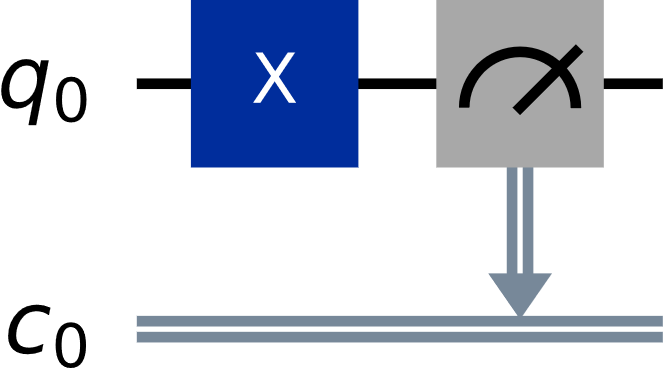
Example of a quantum circuit: a Pauli-X quantum gate being applied to a qubit, followed by a measurement.
Quantum cryptography
Among other things, quantum cryptographic methods allow to securely exchange information between two parties, preventing a third party from being able to eavesdrop on their conversation. This is usually done by exchanging a quantum key that is only known to each of the two parties. Anybody trying to eavesdrop on this communication channel will change the key (see no-cloning theorem), and thus the two parties will know that somebody is eavesdropping.
Quantum gate
A quantum gate is an operation that a quantum computer performs on one or several qubits. A quantum gate transforms the initial state of the qubit(s) – except for the identity gate which leaves the initial state unchanged.

Operator, circuit and matrix representation of the NOT gate
Quantum noise
Quantum noise describes the fact that qubits are very sensitive to temperature fluctuations, electromagnetic disturbances etc. or are simply not indefinitely stable. The consequence is that a certain (small) number of computing steps in a quantum computer can yield wrong results. This is solved by implementing quantum error correction techniques. Lowering quantum noise and improving these techniques is one of the big challenges of quantum computer research.
Quantum supremacy
Describes the superiority of quantum computers over conventional (classical) computers when it comes to solving complex problems. Superior means that it can solve a problem in an acceptable time, whereas a classical computer would require an unreasonably long computation time.
Qubit
A qubit (short for quantum bit) is the quantum-mechanical counterpart of a classical bit. In classical computers, the basic unit of information is the bit which can have two possible values (typically named “” and “”). In quantum computing, the smallest information unit is the qubit – a two-state quantum-mechanical system, like for example the spin of an electron (which can be up and down) or the polarisation of a photon (which can be horizontally or vertically polarized, for example). The two basis states of a qubit are usually represented by and . Whereas the bit can only take the values or , the qubit can be in state , state or in any superposition of states and .
State
The concept of state is central to quantum mechanics. It is an abstract mathematical description holding information about the physical properties of a quantum system. It is usually written as ; in its most general form. A quantum state can be prepared (to have well-defined properties), it can evolve and it determines the probabilities of the outcomes of a measurement.
Superposition
Superposition is the ability of a quantum system to exist in several (basis) states at the same time. For example, a qubit can be in a superposition of the basis states and such as , where and are complex numbers.
As long as no measurement is performed, the qubit exists in the superposition state it was prepared in, allowing quantum computers to process all possible components of the superposition state in a single operation, yielding multiple results simultaneously. This drastically enhances computation efficiency (run time, number of steps).
Wave‑particle duality
Describes the fact that quantum mechanical objects like photons and electrons can both have properties of classical waves (that can interfere, diffract etc.) and properties of classical particles (that have a definite localisation etc.).
Share this page