Basic Concepts of Quantum Computing
Overview
Summary
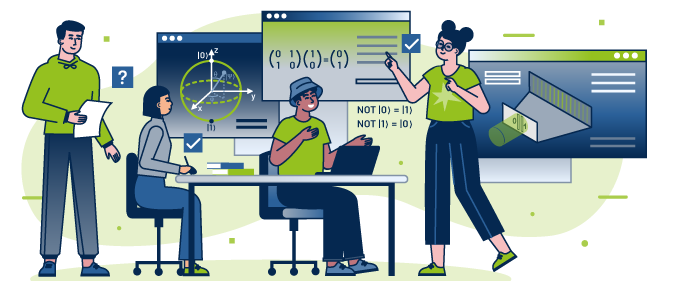
This chapter explores the key concepts needed to understand and program quantum computers. It combines experiments, mathematical foundations and introductory coding activities, supported by flexible teaching units that guide learners from fundamental quantum ideas to simple circuits and algorithms.
Authors: Gerasimos Anagnostopoulos (GR), Natalija Budinski (RS), Christian Datzko (CH), Aleksandr Sorokin (LV), Jörg Thorwart (DE)
Go directly to:
- Basics of Quantum Physics
- An Example for Quantum Supremacy: Quantum Bomb Detection
- Mathematical Basics
- Computer Science Background – Discovering the Supremacy of Quantum Computers
- Qubits, Quantum Gates and Quantum Circuits – A Computer Science Perspective
- Simple Applications: Qubits at Work – From Codebreaking to Climate Modelling
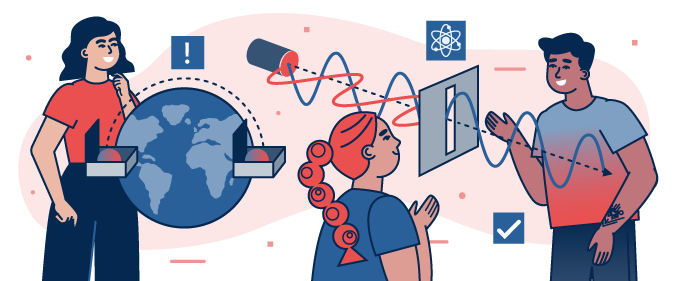
Basics of Quantum Physics
Students receive a brief overview of foundational quantum‑mechanical ideas – state, measurement, and superposition – supported by connections to familiar concepts from classical physics such as wave behavior and wave‑particle duality.
Keywords: Quantum state, quantum measurement, quantum entanglement
Subjects: Physics
Age group: 16 – 19
Required knowledge/skills: Students should be familiar, at least to some extent, with the wave phenomena, especially interference; if not, optional additional material is provided
Time frame: 45 min
An Example for Quantum Supremacy: Quantum Bomb Detection
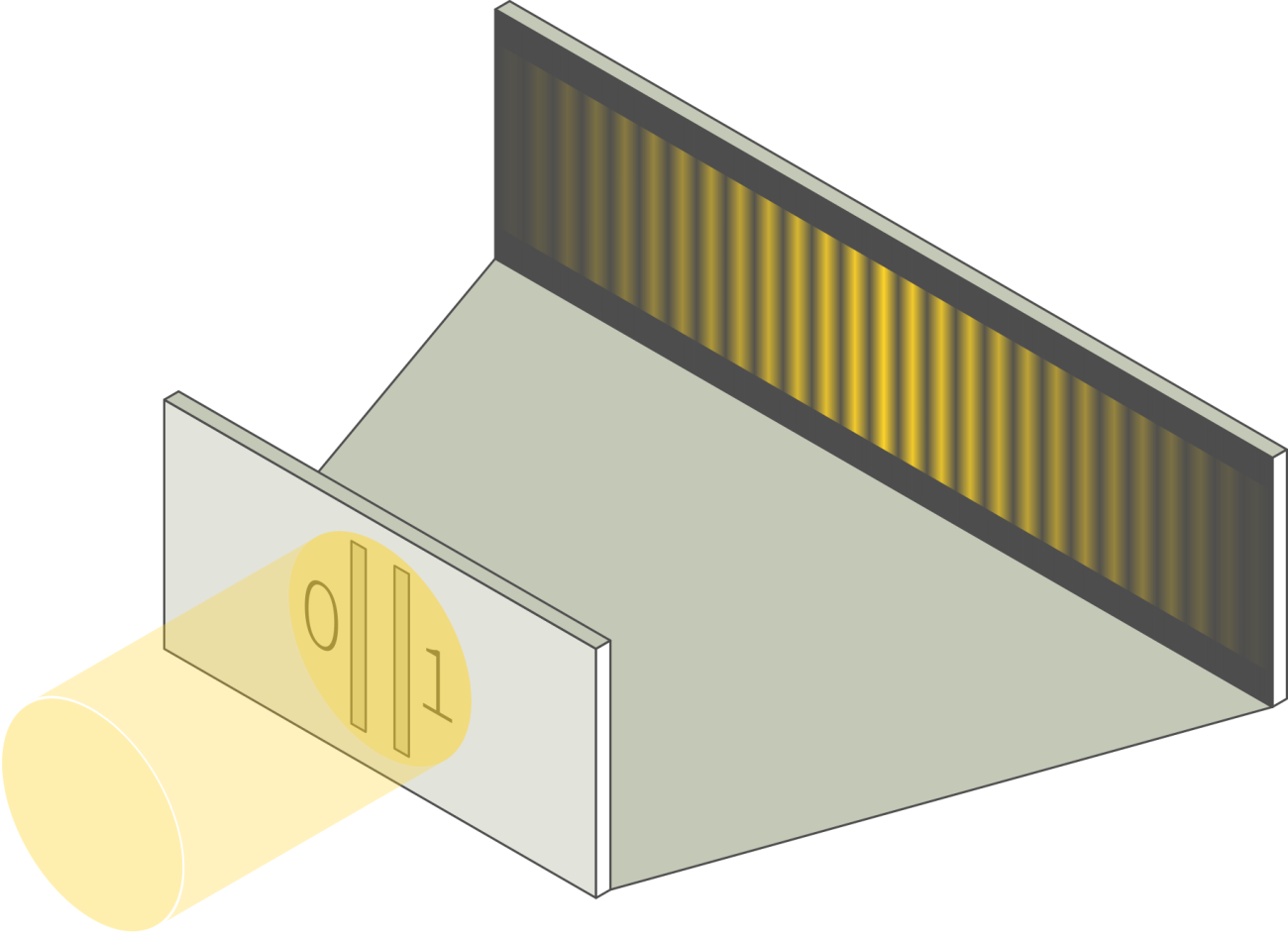
The Elitzur–Vaidman quantum bomb‑detection thought experiment illustrates how superposition and the probabilistic nature of measurements can outperform classical methods. Students explore the underlying concepts through interactive simulations or a teacher‑guided walkthrough using a prepared presentation.
Keywords: quantum state, superposition, interference, quantum supremacy, quantum measurement
Subjects: Physics
Age group: 17 - 19
Required knowledge/skills: Basic knowledge of quantum physics, especially interference of waves, quantum objects, photons
Time frame: 1 x 45 minutes
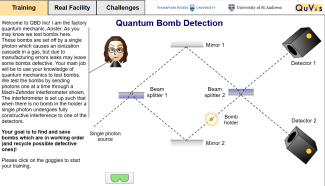
Screenshot QuVis: Quantum Bomb Detection
Mathematical Basics
In this set of lessons, students are introduced to the basic mathematical tools they need to carry out (most of) the other lessons in this project. The lessons on probabilities and matrices are compulsory. The optional lessons introduce students to vector calculation, complex numbers and the Bloch sphere. All lessons come with exercises.
Keywords: Probability, matrices, vectors, complex numbers, Bloch sphere
Subjects: Mathematics
Age group: 16 - 18
Required knowledge/skills: Basic algebra
Time frame: 45 minutes per topic
Go directly to:
- Probability – From classical to quantum
- Quick introduction to complex numbers
- Vectors
- Matrices and how they can be used in quantum computing
- Using the Bloch sphere to represent a qubit
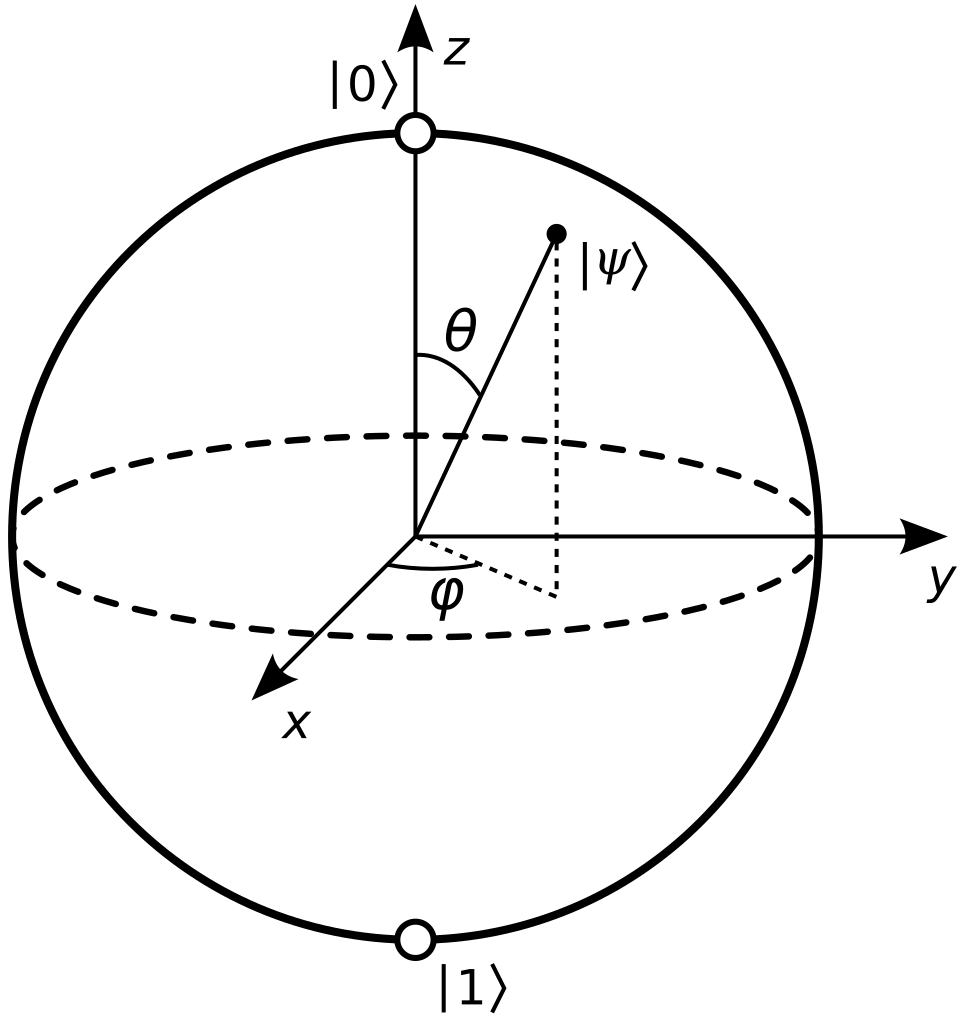
Computer Science Background – Discovering the Supremacy of Quantum Computers
This part explains how computer scientists describe the runtime of algorithms and why some problems become hard for classical computers. It also introduces the RSA encryption method as an example of where quantum algorithms can offer a clear advantage.
Keywords: Computational complexity, Big-O notation, RSA algorithm
Subjects: Computer Science
Age group: 16 - 19
Required knowledge/skills: Basic understanding of structured programming, basic knowledge of the programming language Python
Time frame: 30-45 min
Qubits, Quantum Gates and Quantum Circuits – A Computer Science Perspective
This part introduces the basic elements of quantum computation. Students learn how qubits are represented, how the Pauli‑X, Identity, Hadamard and CNOT gates act on them, and how these operations can be described using vectors and matrices. The concepts are applied by building simple quantum circuits, both through visual programming tools and with the help of IBM’s Qiskit library.
Keywords: Qubit, quantum gate, quantum circuit, basis state, bra-ket notation, graphical interface, Qiskit, superposition, entanglement
Subjects: Computer Science
Age group: 16 - 19
Required knowledge/skills: It helps if students have already covered chapters Basics of Quantum Physics, An Example for Quantum Supremacy: Quantum Bomb Detection, Mathematical Basics and have already heard about Boolean algebra
Time frame: 3 x 45 minutes
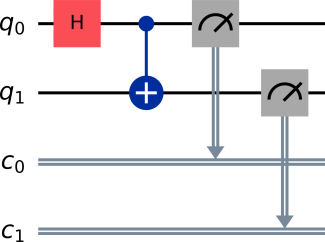
Simple Applications: Qubits at Work – From Codebreaking to Climate Modelling
Students will learn about the possible everyday applications of quantum computers. They are shortly introduced to the most famous quantum algorithms and discover how quantum computing is used in cryptography, molecular design, weather prediction and climate modelling.
Keywords: Quantum computing, quantum algorithm, cryptography, weather prediction, climate modelling, molecular design, bits, qubits
Subjects: Physics, mathematics, computer science, chemistry
Age group: 16 - 19
Required knowledge/skills: none
Time frame: 90 minutes
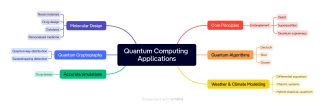
Mind Map
Share this page