From Bits to Quantum Leaps
Overview
Summary
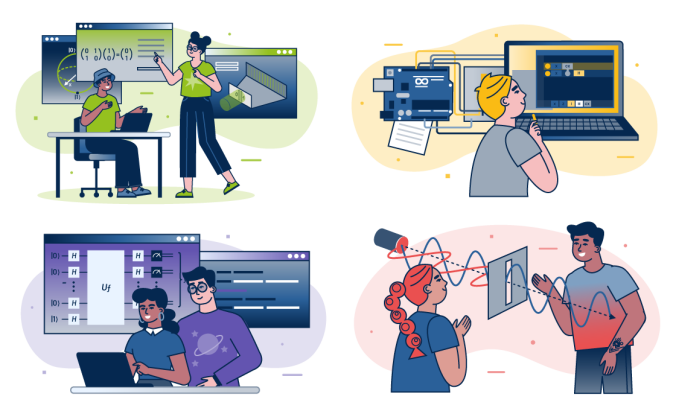
Students start with classical computing and learn about the difference between classical and quantum gates. They can also simulate gates and different quantum phenomena like entaglement and superposition using Arduino. With the quantum machine they can explore different quantum gates while also having a look at the corresponding mathematics.
Authors: Selçuk Yusuf Arslan (TR), Joachim Birk (DE), Clodagh Shine (IE), Astrinos Tsoutsoudakis (GR), Elena Vladescu (RO)
Go directly to:
Classical Computing – Introduction to Binary
Students will be introduced to the world of classic computing through its building blocks of binary. Students will be introduced to binary numbers and how they are used. They will be taught on how to convert from decimals to binary numbers and vice versa.
Keywords: binary numbers, algorithms, math, number conversion
Subjects: computer science, physics, technology, mathematics
Age group: 14-18 years
Required knowledge/skills: Basic mathematical concepts
Time frame: one lesson (45-60 minutes)
| 256 | 128 | 64 | 32 | 16 | 8 | 4 | 2 | 1 | Binary | Decimal |
| 0 | 0 | 0 | 1 | 1 | 1 | |||||
| 0 | 0 | 1 | 0 | 10 | 2 | |||||
| 1 | 0 | 0 | 1 | 0 | 1 | 100101 | 37 | |||
| 1 | 1 | 1 | 1 | 1 | 1 | 1 | 1 | 1 | 111111111 | 511 |
Classical Computing – Introduction to Logic Gates
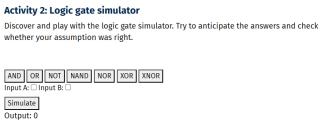
Students will be introduced to the world of classic computing through its building blocks of binary. Students will learn how different logic gates impact these building blocks by using online simulators to experiment with electronic circuits which link logic gates and binary numbers.
Keywords: gates, logic gates, and, or, not
Subjects: computer science, mathematics, physics
Age group: 14-18 years
Required knowledge/skills: prior knowledge of binary numbers, basics of mathematics
Time frame: 2 lessons (45-60 minutes each)
What is a quantum gate and how does it manipulate a qubit?
This teaching unit introduces students to the basic building blocks of quantum computers—qubits and quantum gates—and shows how they differ from classical bits and logic gates. Through hands‑on activities with simulators, students explore superposition, entanglement, and the operation of common gates such as the Hadamard and CNOT.
Keywords: logic gate, quantum gate, bit, qubit
Subjects: computer science, mathematics, physics
Age group: 14+ years
Required knowledge/skills: basic knowledge of matrices and vector calculation
Time frame: 2 x 45 minutes
The Quantum Machine
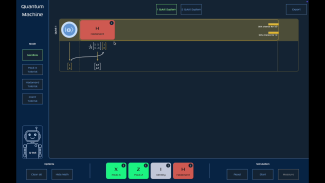
The Quantum Machine is a browser-based tool that allows users to explore the fundamentals of quantum computing through an interactive visual interface. It offers an intuitive way to build and simulate quantum operations without writing a single line of code.
After simulating their circuits, students are encouraged to check the underlying mathematics to deepen their understanding.
Keywords: Quantum gate simulation
Subjects: Mathematics, computer science, technology, physics
Age group: 14+
Required knowledge/skills: familiarity with matrices and introduction to quantum computing in general are helpful
Time frame: 45 min
Simulations with Arduino
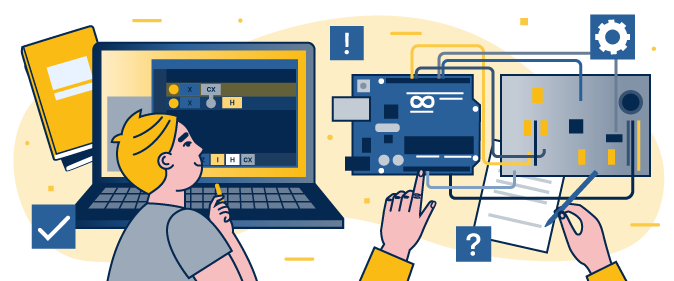
These Arduino simulations introduce key ideas of digital logic and information processing using simple circuits and microcontrollers. They provide a hands-on way to build intuition for concepts that later reappear in quantum computing, such as states, logic operations, and superposition‑like behavior.
Keywords: simulation, Arduino, visualisation, Tinkercad circuits
Subjects: physics, electronics, computer science, mathematics
Age group: 14-17 years
Required knowledge/skills: basic electronics, Arduino programming, circuit design, working in tinkercad.com virtual environment, basic understanding of quantum concepts
Time frame: 1-2 hours each for the first two lessons; 3-4 hours for the third lesson if you realise the entanglement and the superposition simulator.
Go directly to:
Share this page