Mathematical Introduction: Vectors

Overview
Overview
Keywords: vector, linear combination, dot product
Age group: 14-16 years
Required knowledge/skills: algebraic operations
Time frame: 30 minutes
This section is part of Basic Concepts of Quantum Computing – Mathematical Basics written by Natalija Budinski (RS).

After this lesson students will
- understand that vectors are mathematical objects with magnitude and direction;
- be able to perform vector operations such as addition, scalar multiplication, and dot product;
- discover how qubits can be represented as vectors in a 2D complex space.
Required materials
- paper and pencil
What is a vector?
Properties
- A vector has both a magnitude and a direction.
- The zero vector has no direction and its magnitude is 0.
- Equal vectors have the same magnitude and direction.
- A vector is usually denoted by a letter with an arrow on top like so: . Other notations are commonly used too, such as v, v, v̄.
Geometrical representation of a vector
Adding two vectors geometrically is done by placing the tail of the second vector at the head of the first vector. The resulting vector starts from the tail of the first vector and ends at the head of the second vector. This method can be applied to any number of vectors.
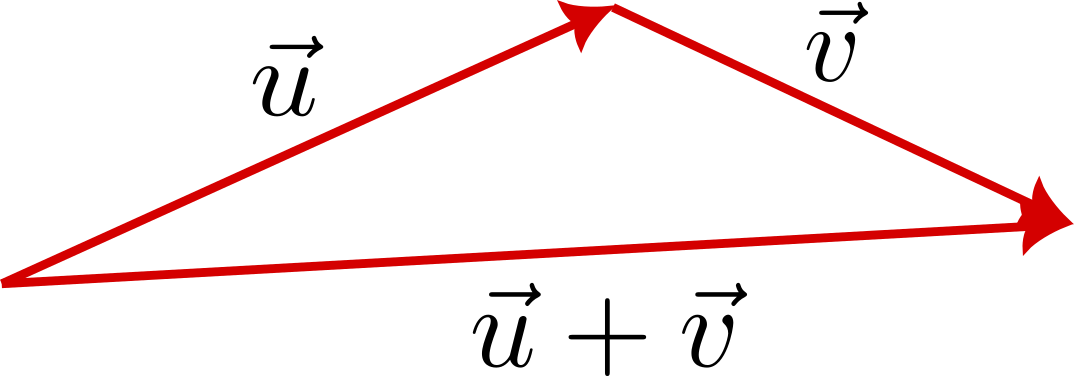
Coordinate representations of a vector
A vector can also be represented in a standard coordinate system. In two dimensions, a vector can be written as a row vector, , or as a column vector, .
In both cases, and can be real or complex numbers.
A row vector is just the sideways version of a column vector. To switch between a row vector and a column vector, one uses the so-called transposition operation, denoted by T:
Basic vector operations
Addition
For two vectors and
Subtraction
For two vectors and
Scalar multiplication
Multiplying a vector by a number (scalar) scales its magnitude without changing its direction (unless the scalar is negative, which also reverses its direction).
For a vector and a scalar , scalar multiplication yields:
Dot product (also called scalar product)
A way to multiply two vectors to produce a scalar is called dot (or scalar) product. For two vectors and , their dot product is
If the dot product of two vectors is zero, , the two vectors are perpendicular.
Magnitude (or norm) of a vector
The magnitude of a vector
The angle between the two vectors can be determined as follows:
, thus:
Calculating with vectors – examples
Let and .
Calculate , and .
Solution
Let and .
Calculate and the angle between the vectors and .
Solution
Vectors in quantum computing
Formally, the state of a qubit is a unit vector in , the two-dimensional complex vector space.
A single qubit can be represented by a 2-dimensional complex vector , where and are complex numbers satisfying , and and .
For example, the state can be represented by the vector
or the state can be represented by the vector .
- B
- B
- B
- A
Share this page