Quantum bomb detection: Tasks Part 1 & 2 with solutions
Context
These tasks for students are part of An Example for Quantum Supremacy: Quantum Bomb Detection, which focuses on essential ideas of quantum computing such as superposition, measurement, and the concept of quantum supremacy. This page gives teachers a complete overview of the worksheets for your students including solutions. You can send the following links to your students for them to access the worksheets (without solutions).
Part 1: Superposition and interference
Go to Setup: Do experiments with a Mach Zehnder Interferometer
Go to task 1: Light as an electromagnetic wave
Go to task 2: Inserting beam splitter 2
Go to task 3: Classical particles
Go to task 4: Light as photon
Go to task 5: Fill in the blanks
Part 2: A measurement destroys the superposition
Students observe how interference and measurement shape a photon's path by adjusting the Quantum Flytrap interferometer setup.
Setup: Do experiments with a Mach–Zehnder interferometer
Open the website with the simulation of a Mach–Zehnder interferometer. Click here: Interferometer experiments
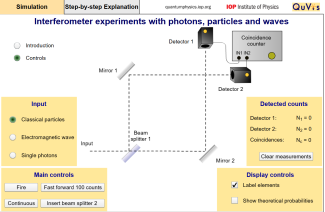
Screenshot QuVis Interferometer
Stay on the Simulation tab and start by activating the radio button Controls to get the setup shown above.
You will now play with the boxes Input and Main controls on the lower left.
Task 1: Light as an electromagnetic wave
In this first step, light is considered to be a classical electromagnetic wave.
Investigate the behaviour of light in the interferometer by checking the radio button Electromagnetic wave. Click on Continuous to have a continuous electromagnetic wave. Make sure not to have inserted beam splitter 2.
- Describe the behaviour of the electromagnetic wave at the first beam splitter and at the mirrors.
- Observe in which detector the wave is detected. You can click on
Fast forward 100 countsto see how often the wave is detected by detector 1 and how often it is detected by detector 2. Explain the result.
Task 2: Inserting beam splitter 2
The light is still an electromagnetic wave. Now add another beam splitter into the path of the light by clicking on Insert beam splitter 2.
- Observe how the setup and the light’s behaviour has changed.
- Observe in which detector the light is detected. Look at the number of counts in the box
Detected counts. - Write down your observations.
Solution
- Without the beam splitter 2, the light wave reaches both detector 1 and detector 2 – the light intensity registered at each detector amounts to 50% of the light intensity of the incoming wave.
- When inserting beam splitter 2, the light wave is detected by detector 2 only (100% of the incoming wave’s intensity).
Explanation
- At beam splitter 1, the incoming wave splits up into two waves, each one having 50% of the incoming wave’s intensity. One wave is reflected at mirror 1, the other one at mirror 2.
- Once these two waves have passed beam splitter 2, they interfere with each other.
- When being reflected at the beam splitters, the waves are phase-shifted. Depending on the phase difference between the two waves after the second beam splitter, one can observe destructive or constructive interference.
- In the direction of detector 1, one observes a destructive interference: the two waves cancel each other, the light intensity is zero, thus nothing is detected.
- In the direction of detector 2, the interference is constructive: the two waves “add up” and the light reaches detector 2. The light intensity detected at detector 2 corresponds to the light intensity of the incoming wave.
Task 3: Classical particles
In a second experiment, we observe the behaviour of classical particles (like very small marbles) and compare it with the behaviour of a wave.
Click on Classical particles in the box Input and insert beam splitter 2.
- Observe and describe the behaviour of classical particles at the beam splitters.
- Click on
Fast forward 100 counts. Describe the number of detections in detector 1 and detector 2. - Why is what is being detected different from what was detected in task 2? Try to find an explanation.
Solution
- At the beam splitters, a classical particle takes either one path or the other.
- The number of particles reaching detector 1 is approximately equal to the number of particles reaching detector 2. The probability that a particle is detected by either one of the detectors is 50%.
- A wave can be “split up” whereas a classical particle cannot.
Explanation using states
- Physicists describe the behaviour of a system by tracking its state(s). To describe the state of a system (e. g. a wave, a particle), they use the so-called (bra)-ket notation. Example: a particle taking the upper path in the interferometer would be described by |up⟩.
- An incoming classical particle that has passed beam splitter 2 can be in two possible states: a particle taking the upper path is described by |up⟩ and is detected by detector 1. Likewise, a particle taking the lower path is described by |right⟩ and is detected by detector 2.
- The following table resumes how the state of the incoming classical particle changes when going through the interferometer.
| State of a classical particle | |
| Initial state | |initial⟩ |
| After beam splitter 1 | either |up⟩ or |right⟩ |
| After beam splitter 2 | either |up⟩ or |right⟩ |
| Detection | 50% of all particles are detected in detector 1 50% of all particles are detected in detector 2 |
Unlike in the case of light being considered as an electromagnetic wave, a classical particle can be detected by both detectors – with an equal probability of 50%.
Conclusion: Light does not behave like a classical particle.
Task 4: Light as a photon
Light can also be described as being composed of “particle-like” quantum objects, called photons. Depending on the experiment, they show properties of particles or waves (also called wave‑particle duality).
Click on Single photons in the Input box. Insert beam splitter 2.
- Investigate what happens when single photons go through the interferometer.
- Describe in which detector the single photons are detected.
- Compare with the behaviour of a classical particle passing through the interferometer.
Solution
- The single photons are detected by detector 2 only (100% probability), whereas classical particles were detected in both detector 1 (50% probability) and detector 2 (50% probability).
Explanation
- Although a photon has properties of a particle, it can simultaneously be in both states, or , taking the upper or the right path, after having passed beam splitter 1.
The single photon is said to be in a superposition of the two states and . The superposition state is written as: .
In the animation, the superposition of the two states is symbolised by the two wave packets (representing the photon) being connected by a dotted line.
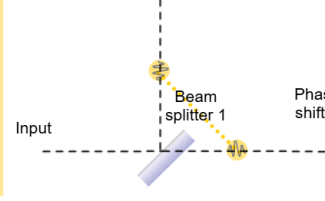
© Screenshot - In order to find out which path the photon takes, you have to perform a measurement. If you square the factors before the states and , in this case , you get the probability that the photon will take the upper or the right path. The probability is in each case, i. e. 50%. Without measuring, the path of the individual photon is not determined.
- After beam splitter 2, the two possible states of the single photon ( and ) interfere – just like the electromagnetic wave. In the direction of detector 1, the interference is destructive, and in the direction of detector 2 it is constructive. Thus, the photon can only be detected by detector 2.
Conclusion
If the photon can be in several possible states, this is called a “superposition state”, like here the state describing the photon going both the upper and the right path. The two states can interfere – just like waves.
Task 5: Fill in the blanks
Fill in the blanks in the following table which resumes the behaviours of a classical particle and a photon passing through a Mach-Zehnder interferometer.
| Classical particle | Photon | |
| Initial state |
|
|
| After beam splitter 1 | ________________________________________ | superposition of two states: |
| After beam splitter 2 | ________________________________________ | ____________________only because ___________________ |
| Detection | ____% of the classical particles are detected by detector 1. ____% of the classical particles are detected by detector 2 | ____% of the classical particles are detected by detector 1. ____% of the classical particles are detected by detector 2 |
| Classical particle | Photon | |
| Initial state |
|
|
| After beam splitter 1 | either or | superposition of two states: |
| After beam splitter 2 | either or | only because of interference |
| Detection | 50% of the classical particles are detected by detector 1. 50% of the classical particles are detected by detector 2 | 0% of the classical particles are detected by detector 1. 100% of the classical particles are detected by detector 2 |
Part 2: A measurement destroys the superposition
Open the website with the Quantum Flytrap game 'Peeking at a photon'. This game was created by Piotr Migdał and designed by Klem Jankiewicz.
The goal of the game is to change the setup of a Mach–Zehnder interferometer such that 50% of the photons reach detector 1 and 50% of the photons reach detector 2.
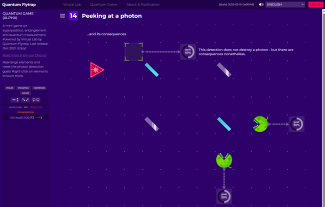
Screenshot Game 'Peeking at a photon'
Task: Get familiar with the setup and modify it
- Emit photons by clicking on the laser. The photon is going into a superposition state, , after it has passed the first beam splitter. After the second beam splitter, the photon is detected by the detector at the right only – due to interference. So, the photon ends up in the state |right⟩ in all cases.
- Find out what you have to change in order for the photon to be detected in both detectors with a 50% probability. Little hint: there is one element that you can move around.
Have you succeeded?
- Reload the webpage and insert the moveable detector in one of the paths, let’s say the right path of the photon.
- Observe the behaviour of the photon as it goes through the interferometer.
- By inserting the movable detector in the right path, you perform a measurement – you check whether the photon took the right path or not. This changes the behaviour of the photon and the superposition state. After the measurement, the photon is either in the right path (it was detected by the movable detector) or in the lower path (it was not detected by the movable detector).
The following table resumes what happens:
| Photon | |
| Initial state |
|
| After beam splitter 1 | superposition state: |
| After the measurement | either or |
| After beam splitter 2 | superposition state: |
| Detection | 50% of the classical particles are detected by detector 1. 50% of the classical particles are detected by detector 2 |
Conclusion
A measurement changes the state of the photon. In the experiment above, it destroys the superposition state . After the measurement, the photon is in either state or .
https://www.st-andrews.ac.uk/physics/quvis/simulations_html5/sims/photons-particles-waves/photons-particles-waves.html
This simulation was created by a team of the University of St. Andrews, UK.
Share this page