Quantum bomb detection: Tasks Part 3 with solutions
Context
These tasks for students are part of An Example for Quantum Supremacy: Quantum Bomb Detection, which focuses on essential ideas of quantum computing such as superposition, measurement, and the concept of quantum supremacy. This page gives teachers a complete overview of the tasks including solutions.
You can send the following link to your students for them to access the worksheet (without solution.)
Part 3: Quantum Bomb Detection
Go to setup: Quantum Bomb Detection Simulation
Go to task 1: Getting to know the simulation
Go to task 2: Setup without a bomb
Go to task 3: Bomb in the lower path
Go to task 4: Checking Bombs
Go to task 5: Fill in the blanks
Go to Optional tasks
Here you find a link to the interactive worksheet without solutions that can be directly used with students:
Setup: Quantum Bomb Detection Simulation
Open the website with the "Quantum Bomb Detection" apparatus.
Detect a working bomb without destroying it.
You have a batch of light-sensitive bombs. Some of them are working and will explode when hit by a photon, while others are defective and will not explode.
Can you identify some of the working bombs without causing them to explode? Classically, that is not possible. But using quantum physics – superposition and interference –, it is!
Click on the green goggles to get the following set up.
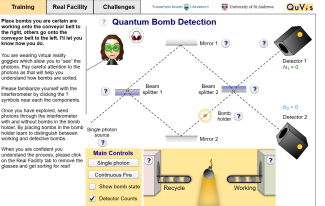
Screenshot: Quantum Bomb Detection Simulation "wearing" virtual reality goggles showing the photons
Task 1: Getting to know the simulation
Have a play with the Simulation for a few minutes, getting to understand the controls and displays. Note three things about the controls and displayed quantities that you have found out.
Task 2: Setup without a bomb 2
Consider the setup when there is no bomb.
- What are the probabilities for detecting the photon in detector 1 and detector 2 respectively?
- Explain whether, after passing beam splitter 1, the single photon is taking both paths simultaneously (superposition), or is actually taking only one path (either the upper or the lower path, but we can't tell which one). Justify your answer by considering the detection probabilities from part 1.
Task 3: Bomb in the lower path
Now, consider the setup with a bomb inserted in the lower path.
- If the bomb is defective, it will not explode when hit by a photon. What are the probabilities for setting off the bomb and for detecting the photon in detector 1 and detector 2 respectively if the bomb is defective. Explain your answer.
- If the bomb is working, it will explode when hit by a photon. What are the probabilities for setting off the bomb and detecting the photon in detector 1 and detector 2 respectively in this case. Explain your answer.
Task 4: Checking bombs
Start checking bombs. You may check the bomb state after firing a photon. Repeat the procedure with several bombs – at least until you detect a photon in detector 2. What does this tell you about the bomb? Explain.
Task 5: Fill in the blanks
Complete the following text:
If the bomb is defective, the photon will always be detected by detector 1 since the superposition state is not ___affected (or influenced)____ by the bomb and because of interference after beam splitter 2.
For a working bomb, there is a ___50%___ probability for the bomb to explode. This is equivalent to performing a measurement. The result of the measurement answers the question: “Which path did the photon take?”.
After the “measurement”, the photon might be in the state |up⟩, and the bomb will not have exploded when the photon reaches beam splitter 2.
At beam splitter 2, a new ___superposition___ state is created and the photon can be observed in detector 1 with a 50% probability and in detector 2 with a 50% probability as well.
Since observing the photon in detector 2 is only possible for a working bomb, this case allows us to say: we know for sure that the bomb is working although it did not explode.
That would not have been possible with classical physics!
Optional Tasks
- Click on the tab
Challenges. Get as far as you can. - Click on the tab
Real facility. Try to correctly identify 10 bombs as working or defective.
The missing words are: affected (or influenced), 50%, superposition.
Share this page