Simple Applications: Qubits at work – from codebreaking to climate modelling

Overview
Overview
Keywords: Quantum computing, quantum algorithm, cryptography, weather prediction, climate modelling, molecular design, bits, qubits
Age group: 16-19
Required knowledge/skills: none
Time frame: 90 min
More information: Careers in Quantum Technologies
Author(s): Gerasimos Anagnostopoulos (GR)

Required materials
- Computers or tablets
- Access to the internet
Structure of the teaching unit
The teaching material is meant as an introduction to quantum computing both for teachers and students. For teachers: Familiarise yourself with applications of quantum algorithms such as the Deutsch, Deutsch-Jozsa, Shor and Grover algorithms in the teaching unit The Supremacy of Quatum Algorithms.
Some parts have (interactive) worksheets for students.
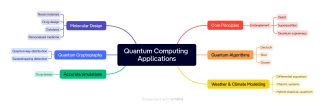
Mind Map
Quantum Computers are fast - Quantum Computing Supremacy
Quantum computers can solve certain problems much faster than classical computers. They excel at tasks like cracking codes, designing new molecules for medication or biotechnology, or optimising complex systems like climate models. The increase in speed for running a program on a quantum computer comes from special properties of quantum physics – such as superposition and entanglement –, which allow quantum computers to run programming steps in parallel rather than sequentially, i.e. one after the other. Here, “parallel” does not mean classical parallel computing where computers run parts of a computer program in parallel – each part on a different CPU core. In quantum computing, parallel means that processes that require several steps on a classical computer are performed in a single step on a quantum computer.
Quantum supremacy refers to the fact that a quantum computer solves some specific computational problems significantly faster than the most advanced classical supercomputers. However, this does not mean that quantum computers are universally superior: they cannot solve just any problem more efficiently than classical computers. Today’s challenge consists in developing quantum computers that are capable of solving real-world applications – beyond mere demonstrations of their supremacy.
In recent years, major tech companies such as Google, IBM and Microsoft have made significant advancements in quantum computing hardware. Google's processors, like Sycamore and more recently Willow, have demonstrated quantum supremacy. Google emphasises qubit performance and scalability. IBM has steadily expanded its quantum computing capabilities, recently unveiling processors with more than 400 qubit, focusing on improved coherence times and error rates – which means: to obtain more stable qubits – to enhance the reliability of the computing results. IBM also provides cloud-based quantum computing platforms (IBM Quantum). Microsoft is pursuing a different approach to have stable qubits: its aim is to develop robust, error-resistant qubits, although this technology is still largely experimental.
A qubit (short for quantum bit) is the quantum-mechanical counterpart of a classical bit. In classical computers, the basic unit of information is the bit which can have two possible values (typically named “0” and “1”). In quantum computing, the smallest information unit is the qubit – a two-state quantum-mechanical system. See other lessons in this teaching module for further details.
Whereas Google, Microsoft and IBM currently dominate the quantum computing field, Europe is becoming increasingly active. Many companies have been created in recent years, developing different types of quantum computers: IQM (Finland – superconducting quantum computers), Pasqal and Quandela (France – quantum computers working with laser cooled neutral atoms resp. photons), Quantinuum (UK/US – trapped-ion quantum computers), AQT (Austria – trapped-ion quantum computers), ORCA Computing (UK – photonic computers) or Oxford Quantum Circuits (UK – superconducting quantum computers). Each of these companies contributes uniquely to the development of quantum computing, following diverse technical paths towards practical quantum applications.
It should be stressed that quantum computers are not yet technologically advanced enough to be deployed for everyday use. As of today, the state is more to show that a puzzle can be solved – but this puzzle does not have real-world benefits.
Share this page