An Example for Quantum Supremacy: Quantum Bomb Detection

Overview
Overview
Keywords: quantum state, superposition, interference, quantum supremacy, quantum measurement
Age group: 17 - 19
Required knowledge/skills: Basic knowledge of quantum physics, especially interference of waves, quantum objects, photons (also see "Basics of quantum physics")
Time frame: 1 x 45 minutes
Author: Jörg Thorwart (DE)
The idea behind this lesson is a thought experiment developed by Elitzur and Vaidman in 1993.
One has a batch of light-sensitive bombs. Some are working, while others are defective. Using classical physics, one can only identify a working bomb by interacting with it, i. e. by shining light on it. If the bomb is working, it will explode. If it is defective, nothing will happen.
Using quantum physics, one gets an advantage over classical physics. In a specific experimental setup using a Mach-Zehnder interferometer, one has a 25% chance of detecting a working bomb without causing it to explode. This is an example for an interaction-free measurement that uses two quantum concepts: superposition and measurement. These concepts are important when using and programming quantum computers.
Further details about how a Mach-Zehnder interferometer and the bomb detection work can be found in the worksheets for students and the resources mentioned at the end of this unit.
Learning objectives:
- The students become familiar with concepts that are essential for quantum computing: superposition and measurement of quantum objects
- The students discover quantum supremacy, i.e. how quantum physics has an advantage over classical physics.
In part of this lesson, students are expected to work independently with minimal input from the teacher. They will solve tasks on their own by using interactive simulations/games:
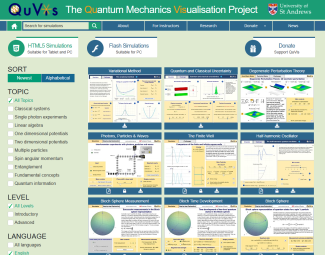
- The Quantum Mechanics Visualization Project (QuVis) created at the University of St. Andrews
- The Quantum Flytrap. The game is available in several languages.
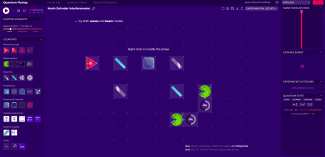
Screenshot Quantum Flytrap
Structure of the unit
This lesson is based on two student activities and a PowerPoint presentation. The activities and files are designed in such a way that the students can work with them independently with minimal input from the teacher. The solutions are included in the version for teachers.
The first part of the activity is covered by Tasks Part 1 and 2; the goals and structure are:
- To understand the setup of a Mach-Zehnder interferometer using the simulation of the University of St. Andrews (10 mins). Click here: Interferometer experiments
- To investigate the behaviour of a classical particle vs. the behaviour of a photon (a quantum object) in the Mach-Zehnder interferometer (10 mins).
- To be able to explain the observed interference effects for a single photon using the concept of superposition.
- To investigate what happens when a measurement is performed on the superposition state of the photon using the Quantum flytrap simulation (5 mins). Click here: Game 'Peeking at a photon'
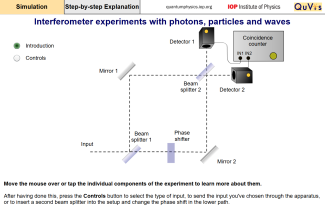
Screenshot QuVis Interferometer experiments
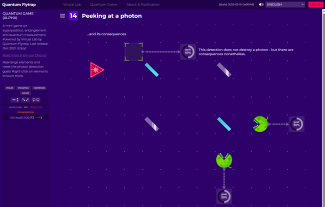
Screenshot Game 'Peeking at a photon'
The second part of the activity covers the quantum bomb detection itself. To explain the experiment, the teacher can use a presentation (approx. 15 minutes). The presentation explains how to detect working light-sensitive bombs without making them explode, using a Mach–Zehnder interferometer.
At the end of the presentation, the students get the task to apply and test their knowledge using the simulation Quantum Bomb Detection. This task might also be assigned as homework.
Download the presentation as pdf or as pptx.
As an alterantive to the presentation, the students can explore the experiment using the interactive worksheet Tasks Part 3. This activity is more time-consuming and demanding. It might be better suited for advanced or fast-working students or as a homework assignment.
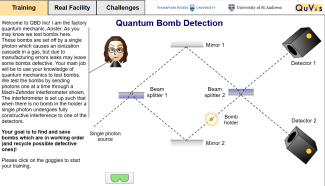
Screenshot QuVis: Quantum Bomb Detection
References
Here you can find all links and online material that has been mentioned and used to develop this lesson. The links could be passed on to the students to deepen their knowledge:
QuVis - The Quantum Mechanics Visualisation Project (University of St Andrews)
(last accessed 15.04.2026)Quantum Flytrap (created by Piotr Migdał and designed by Klem Jankiewicz)
(last accessed 15.04.2026)Interferometer experiments with photons, particles and waves
(last accessed 15.04.2026)'Peeking a photon' (Quantum Flytrap)
(last accessed 15.04.2026)Quantum Bomb Detection (QuVis)
(last accessed 15.04.2026)The links could be passed on to the students to deepen their knowledge:
The original paper by Elitzur and Vaidman: Elitzur, Avshalom C.; Lev Vaidman (1993). "Quantum Mechanical interaction - Free Measurements" . Foundations of Physics. 23 (7): 987–997, arXiv:hep-th/9305002
(last accessed 15.04.2026)Worksheets from the QuVis website: QuVis materials are distributed under a CC-BY-NC-SA license. Instructors are welcome to modify activities as needed.
(last accessed 15.04.2026)For a more detailed explanation of the setup of a Mach-Zehnder interferometer, see the lesson on the “Quantum machine” as well as the PhysicsOpenLab website.
(last accessed 15.04.2026)YouTube video by physicist Sabine Hossenfelder about the bomb experiment: Why is quantum mechanics weird? The bomb experiment
(last accessed 15.04.2026)

Share this page